Humanoid Robot Parts for Bipedal Balance
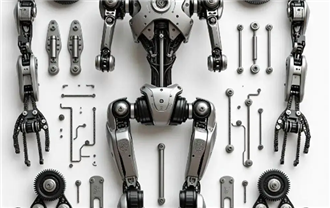
Date:2026-09-26Article editor:Starting Point PrecisionViews:194Bipedal humanoid robots rely on precise mechanical structures to achieve stable walking, accurate movement, and efficient energy control. Components such as joint brackets, motor mounts, and support frames must maintain high strength while minimizing weight.
The manufacturing of Humanoid Robot Parts requires advanced machining methods to achieve complex geometries, tight tolerances, and reliable assembly performance. CNC machining provides an effective solution for producing customized robotic components used in prototype development and production applications.
For customized precision machining services, Start Precision provides manufacturing solutions for complex industrial components.
Humanoid robot structures experience continuous movement and mechanical loads. Therefore, their components need to meet strict performance requirements.
| Requirement | Manufacturing Focus |
| Lightweight structure | Reduce weight while maintaining strength |
| Dimensional accuracy | Ensure precise robotic assembly |
| Structural reliability | Support repeated motion cycles |
| Complex geometry | Produce advanced mechanical designs |
Common CNC machined humanoid robot components include:
● Joint brackets
● Motor housing parts
● Structural support frames
● Precision mounting plates
● Custom connection components
CNC Machining Process for Humanoid Robot Components
Producing reliable robotic parts requires careful control throughout the manufacturing process.
Before production begins, engineers review 3D models, technical drawings, and assembly requirements. Critical areas such as joint interfaces, mounting positions, and weight-reduction structures are analyzed to develop an appropriate machining approach.
Materials are selected according to strength, weight, and application requirements. Aluminum alloys are often used for lightweight structures, while stainless steel and titanium alloys are chosen for higher strength applications.
Proper fixtures and machining parameters are prepared to ensure stability during CNC processing.
CNC milling and turning technologies are used to manufacture complex robot parts with accurate dimensions. Advanced machining methods allow manufacturers to create curved surfaces, precision holes, and detailed structures required for humanoid robot assemblies.
After machining, components undergo deburring, surface finishing, and dimensional inspection. These processes help ensure that each part meets design specifications and assembly requirements.
More information about Start Precision machining capabilities: https://www.startprecision.com/precision/
Material selection directly influences robot performance, durability, and weight.
| Material | Advantages |
| Aluminum Alloy | Lightweight, corrosion resistant, easy machining |
| Stainless Steel | High strength and wear resistance |
| Titanium Alloy | Excellent strength-to-weight ratio |
Material performance information can also be referenced through: https://www.matweb.com/
Our manufacturing process focuses on accuracy, consistency, and production reliability.
● Analyze customer drawings and 3D models
● Select suitable materials based on application needs
● Optimize machining methods for complex structures
● Control machining conditions during production
● Verify final dimensions before shipment
Through controlled CNC manufacturing and inspection procedures, robotic components can achieve stable performance in demanding applications.
A robotics developer required lightweight joint brackets for a bipedal robot prototype. The components needed precise mounting positions, reduced weight, and reliable mechanical strength.
The manufacturing solution included aluminum alloy CNC machining, optimized tool paths for complex surfaces, and dimensional inspection after production.
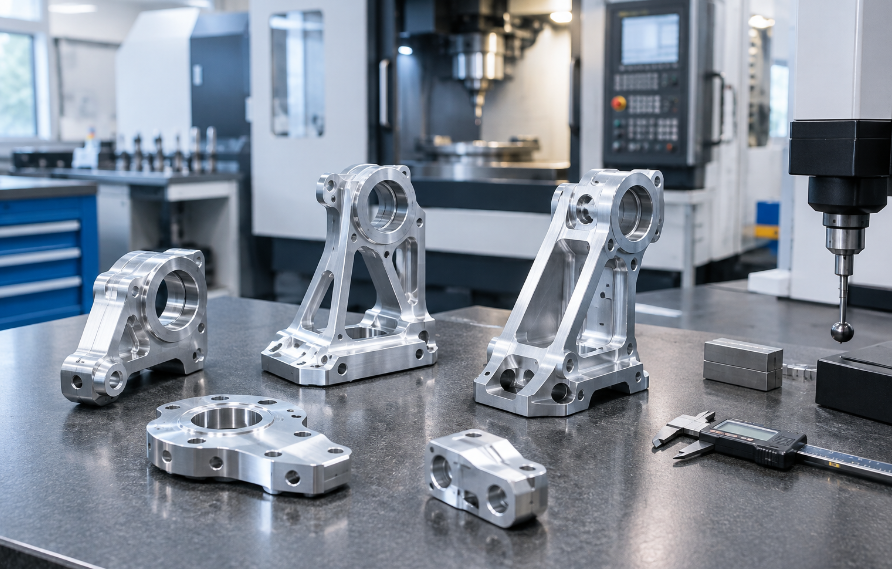
The completed parts achieved accurate assembly performance and supported further development testing of the humanoid robot system.
High-quality Humanoid Robot Parts are essential for improving bipedal balance, movement accuracy, and overall robotic reliability. With precision CNC machining, proper material selection, and controlled manufacturing processes, complex robotic components can be produced to meet advanced automation requirements.
Contact us to discuss your manufacturing needs and develop customized CNC machining solutions for humanoid robot applications.
Frequently Asked Questions (FAQ)
CNC machining can produce joint brackets, motor mounts, structural frames, connection parts, and other precision robotic components.
CNC machining provides high accuracy, repeatability, and flexibility for manufacturing complex metal structures.
Aluminum alloy, stainless steel, and titanium alloy are commonly selected according to strength and weight requirements.
Yes. CNC machining is suitable for prototype development, functional testing parts, and small-batch production.
Add: Building 3No.277 Zhen'an Middle Road, Chang'an Town,Dongguan,Guangdong, China
Tel:+86-769-82855591
Copyright © 2019 All Rights Reserved Dongguan Start Precision Technology Co., Ltd. Tel: +86-769-82855591
Add: No. 277 Zhen'an Middle Road, Chang'an Town, Dongguan, Guangdong, China



 中文版
 English