Custom CNC Machining Parts: Black Oxide vs Zinc Plated – Which Offers Better Rust Protection?
Date:2026-06-11Article editor:Starting Point PrecisionViews:437When manufacturing custom CNC machining parts, choosing the right surface finish is critical for durability and corrosion resistance. Two popular options are black oxide and zinc plating. Both protect against rust, but they work differently. This article compares black oxide vs zinc plated machining rust protection to help you decide which coating suits your application.
CNC machined components—especially those made from carbon steel or low-alloy steel—are vulnerable to oxidation. Moisture, chemicals, and humidity can quickly degrade unprotected parts, leading to failure. Applying a protective layer extends service life and maintains dimensional accuracy. The two most cost-effective solutions are black oxide and zinc plating.
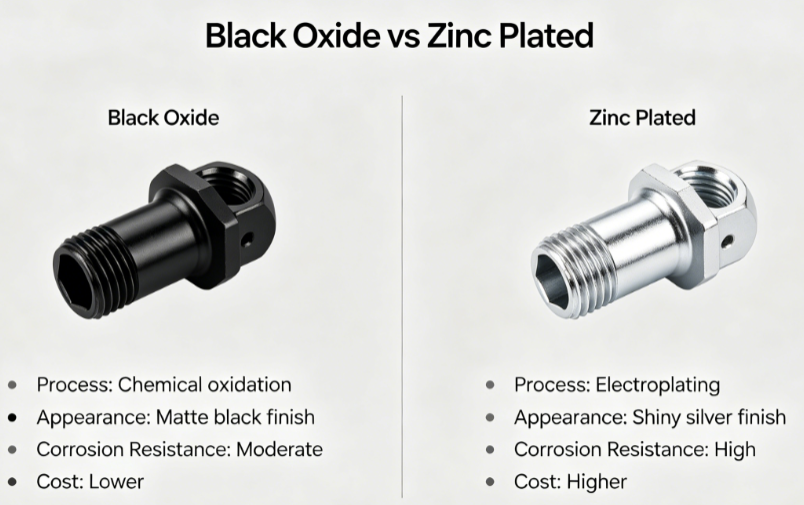
Black oxide is a conversion coating produced by dipping parts in a hot alkaline salt solution. It creates magnetite (Fe₃O₄) on the steel surface. Unlike electroplating, black oxide adds negligible thickness (0.5–1.5 microns) and does not alter part dimensions—ideal for tight-tolerance custom CNC machining parts.
Rust protection mechanism: Black oxide alone offers only mild corrosion resistance. It works best when combined with oil, wax, or sealant. The oil fills microscopic pores, providing a barrier against moisture. Without post-treatment, black oxide parts can rust within hours in humid environments. However, with regular oiling, they withstand indoor storage and mild conditions.
Advantages:
● No dimensional change
● Matte black finish reduces light reflection
● Improves lubricity (oil retention)
● Low cost
Limitations: Poor performance in salt spray or outdoor exposure.
Zinc plating deposits a metallic zinc layer via electrolysis. Typical thickness ranges from 5 to 25 microns. Zinc acts as a sacrificial anode—it corrodes before the base steel, offering galvanic protection even if scratched.
Rust protection mechanism: Zinc forms zinc carbonate (a stable patina) when exposed to air. Additional passivation (clear, yellow, or black chromate) boosts salt spray resistance up to 120+ hours. For harsh environments, zinc plating outperforms black oxide significantly.
Advantages:
● Excellent corrosion resistance (indoor and outdoor)
● Sacrificial protection
● Various color options (clear, yellow, black)
● Higher hardness and abrasion resistance
Limitations:
● Adds thickness (may affect threaded holes)
● Risk of hydrogen embrittlement for high-strength steels
● Higher cost than black oxide
| Feature | Black Oxide | Zinc Plated |
| Coating thickness | <2 microns | 5–25 microns |
| Rust protection (salt spray) | 0–2 hours (without oil) | 72–120+ hours (with chromate) |
| Dimensional change | None | Slight (+0.0002″ to 0.001″) |
| Appearance | Matte black | Silver, yellow, black, etc. |
| Sacrificial protection | No | Yes |
| Cost per part | Low | Medium |
| Best for | Indoor precision parts, tools, firearms | Outdoor hardware, automotive, marine |
Choose black oxide if:
● Tolerances are critical (e.g., valve bodies, precision shafts)
● Parts operate indoors or with regular oiling
● You need a non-reflective black finish
● Budget is extremely tight
Choose zinc plating if:
● Parts face moisture, salt, or chemicals
● You require long-term outdoor durability
● Scratches are possible (sacrificial protection needed)
● Appearance flexibility matters
For most custom CNC machining parts that see occasional moisture, a black oxide plus oil finish is adequate. For demanding applications like agricultural machinery or automotive brackets, zinc plating is the safer bet.
For a deeper dive into surface finishing, see our Surface Finishing guide.
Learn about ASTM B633 (zinc plating standard) .
Q1: Can black oxide be used outdoors?
No. Without regular oiling or a topcoat, black oxide will rust quickly outdoors. It is intended for indoor or controlled environments.
Q2: Does zinc plating change thread dimensions?
Yes. Zinc adds 5–25 microns per side, which can tighten threads. For critical threads, specify “after-plate” tapping or reduce pre-plate dimensions.
Q3: Which is more environmentally friendly?
Black oxide (hot salt bath) produces less toxic waste than zinc plating, which involves cyanide or acid baths. However, modern trivalent chromium passivation reduces zinc plating’s environmental impact.
Q4: How long does zinc plated rust protection last?
In typical indoor conditions, 10–20 years. In moderate outdoor exposure, 2–5 years before white rust appears. Yellow chromate zinc lasts longer than clear.
Q5: Can I apply both coatings?
Not practically. Zinc plating requires a conductive surface; black oxide is a conversion layer. Choose one based on performance needs.

Add: Building 3No.277 Zhen'an Middle Road, Chang'an Town,Dongguan,Guangdong, China
Tel:+86-769-82855591
Copyright © 2019 All Rights Reserved Dongguan Start Precision Technology Co., Ltd. Tel: +86-769-82855591
Add: No. 277 Zhen'an Middle Road, Chang'an Town, Dongguan, Guangdong, China



 中文版
中文版 English