CNC Copper Parts for Electrical Terminals
Date:2026-10-08Article editor:Starting Point PrecisionViews:161Electrical terminals need more than a conductive material. Their contact surfaces, mounting features, dimensions, and connection geometry must remain consistent during assembly and service. CNC copper parts for electrical terminals provide a practical solution when terminal components require accurate holes, slots, shoulders, contact faces, or custom geometries.
Copper is widely used for electrical applications because of its high electrical conductivity. The Copper Development Association notes that commercially pure copper can exceed 100% IACS, while alloy selection requires balancing conductivity with strength, corrosion resistance, and manufacturability.
For custom production, Start Precision uses CNC machining methods to turn copper stock into application-specific electrical components.
Electrical terminals often combine conductive requirements with mechanical features. A machined terminal may need to fit a busbar, accept a screw, locate a cable, or maintain a controlled contact area.
Key benefits include:
• High electrical conductivity for current-carrying applications
• Accurate holes and mounting interfaces
• Repeatable dimensions for assembly consistency
• Flexible production of complex terminal geometries
• Support for prototypes, low-volume orders, and production batches
Copper alloy selection should be based on the actual electrical and mechanical requirements rather than conductivity alone. For example, C11000 is commonly associated with electrical products such as contacts, switches, and terminals.
A controlled machining workflow helps protect both dimensional accuracy and surface quality.
| Process | Manufacturing Focus |
| Drawing Review | Confirm dimensions, tolerances, threads, and contact areas |
| Material Preparation | Verify copper grade, stock size, and material requirements |
| CNC Milling/Turning | Produce the main terminal geometry |
| Hole & Thread Machining | Create mounting and connection features |
| Precision Finishing | Control contact surfaces and critical dimensions |
| Deburring | Remove burrs around holes, slots, and edges |
| Inspection | Verify dimensions, geometry, and visual quality |
| Final Release | Clean, package, and prepare parts for shipment |
Copper can behave differently from harder machining materials, so tool condition, cutting parameters, workholding, and chip evacuation must be managed carefully. Sharp tooling and stable fixturing are especially important when producing small terminal features.
When machining copper terminal parts, we pay particular attention to:
• Contact surfaces: Flatness and surface condition can affect electrical connection quality.
• Mounting holes: Hole diameter and positional accuracy help prevent assembly problems.
• Threads: Thread quality must match the mating fastener without damaging the softer copper material.
• Edges and slots: Burr control is important where terminals interface with cables, connectors, or insulation.
• Dimensional repeatability: Consistent production dimensions help simplify downstream assembly.
Electrical conductivity is commonly expressed as %IACS, and alloying or processing can change conductivity. Therefore, the specified copper grade should be confirmed before machining begins.
A customer required a compact copper terminal with a mounting hole, cable connection area, and controlled contact face. The original drawing contained several closely related dimensions that had to remain consistent across the production batch.
The machining approach included:
1. Reviewing the drawing and identifying critical contact and mounting features.
2. Preparing the specified copper material and checking the stock dimensions.
3. CNC machining the primary profile and connection geometry.
4. Finishing the mounting hole and other critical features.
5. Removing burrs without damaging the contact surfaces.
6. Inspecting key dimensions before final cleaning and packaging.
The result was a repeatable terminal component designed for straightforward installation and reliable electrical connection.
For projects involving custom copper electrical terminals, manufacturing decisions should be made from the drawing, material specification, tolerance requirements, and intended application.
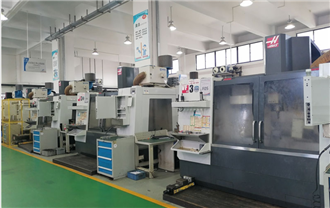
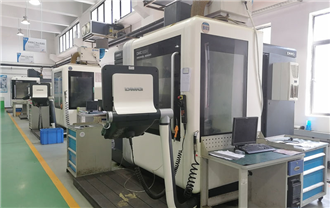
You can also review the Precision equipment and machining capabilities available from Start Precision when evaluating a production partner.
For technical background on copper conductivity and alloy selection, the Copper Development Association provides useful engineering information.
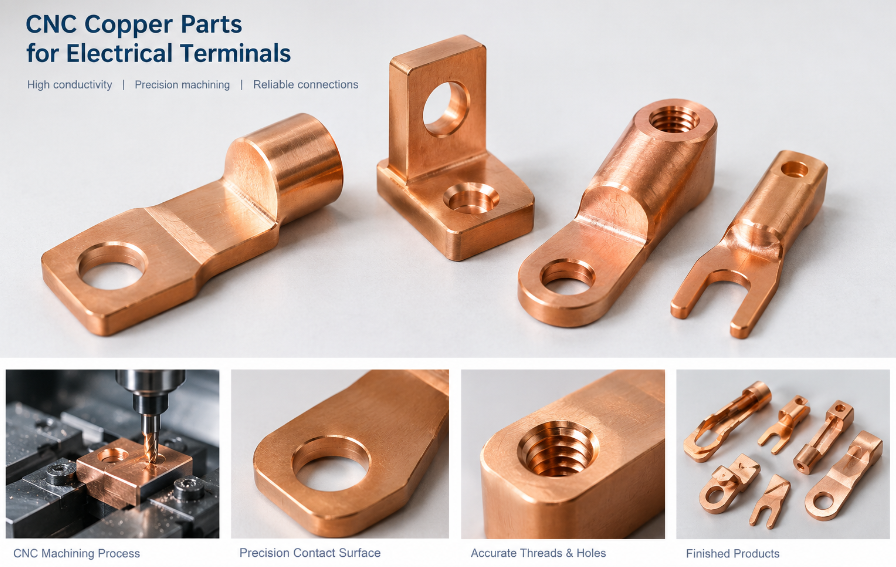
CNC copper machining allows electrical terminal manufacturers to combine conductivity with accurate mechanical geometry. By controlling material selection, machining, deburring, and inspection, custom copper terminals can be produced consistently for different electrical applications.
Contact us to discuss your manufacturing needs and share your drawings, material requirements, quantities, and tolerance specifications.
1. What copper materials can be used for electrical terminals?
Common choices include commercially pure copper and selected high-copper alloys. The best material depends on conductivity, strength, forming requirements, and the operating environment.
2. Can CNC machining produce small copper terminals?
Yes. CNC machining can produce compact terminals with precise holes, slots, threads, contact faces, and other detailed features.
3. How do you control burrs on copper terminal parts?
Machining parameters, sharp tooling, stable fixturing, and controlled deburring are used to reduce burrs without damaging critical contact surfaces.
4. Can custom copper terminals be made from customer drawings?
Yes. Production can be based on 2D drawings, 3D CAD models, material specifications, tolerances, and quantity requirements.
5. Are copper terminal parts suitable for prototype and production orders?
CNC machining can support both prototype quantities and repeat production, depending on the component design and required volume.
Add: Building 3No.277 Zhen'an Middle Road, Chang'an Town,Dongguan,Guangdong, China
Tel:+86-769-82855591
Copyright © 2019 All Rights Reserved Dongguan Start Precision Technology Co., Ltd. Tel: +86-769-82855591
Add: No. 277 Zhen'an Middle Road, Chang'an Town, Dongguan, Guangdong, China



 中文版
 English