Precision Custom Metal Parts Machining China: Maximize Efficiency with Quick-Change Tool Posts
Date:2026-06-05Article editor:Starting Point PrecisionViews:454China has long been a global leader in custom metal parts machining, offering high-quality, cost-effective solutions for industries ranging from automotive to medical devices. However, to truly stay competitive, manufacturers need more than just precision cutting – they need rapid setup capabilities. That’s where quick-change tool posts come into play. By integrating quick-change tooling systems into CNC lathes and turning centers, Chinese machine shops can slash downtime, boost throughput, and deliver superior custom parts with tighter tolerances.
A quick-change tool post (also known as a quick-change tool holder or tool post system) allows operators to swap cutting tools in seconds without losing repeatable positioning. Traditional turret or four-way tool posts may require shimming, realignment, and lengthy adjustment. With a quick-change system, each tool is pre-set in its own holder. When a job changes, the operator simply unlocks, removes one holder, and clicks in the next – all while maintaining micrometer-level accuracy.
According to Sandvik, quick-change systems can reduce tool change time by over 80%. For a shop running 20 setups per day, that saves hours of productive machining time. Below is an example of a typical quick-change tool post setup.
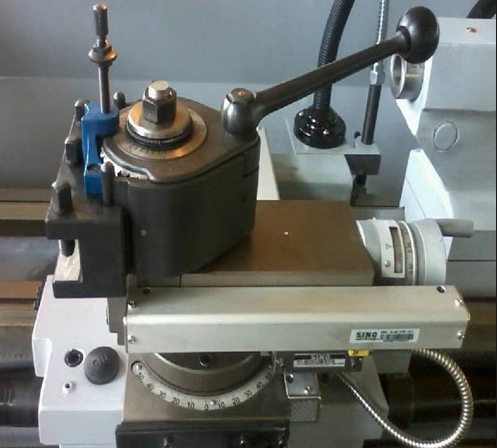
Quick-change tool posts transform the efficiency of custom metal parts machining in China in several critical ways:
Faster changeovers between custom orders – Many Chinese machine shops serve small-batch, high-mix customers (e.g., 50 pcs of a valve body, then 200 pcs of a shaft). Quick-change posts allow switching from external turning to boring to threading in under one minute.
Reduced skilled labor dependency – Pre-set tool heights eliminate manual adjustment errors, making it easier for less experienced operators to maintain consistency.
Higher spindle utilization – Less time stopped for tool changes means more chips per hour, directly lowering part cost.
Ideal for just-in-time delivery – Chinese exporters offering 7-15 day lead times can rely on quick-change systems to meet tight schedules without overtime.
For example, a Guangdong-based job shop reduced setup time from 45 minutes to 9 minutes per order after retrofitting their manual lathes with quick-change tool posts. That shop now advertises “rapid prototyping” as a core service .
When evaluating vendors, ask: Do they use quick-change tool posts on their turning equipment? Do they have standardized tool presetters? What is their average setup time per order? Shops that invest in quick-change systems often signal a commitment to lean production and on-time delivery.
Combining custom metal parts machining in China with quick-change tool posts unlocks a powerful competitive advantage: fast, accurate, and cost-efficient production. Whether you need 100 parts or 10,000, ensure your supplier uses modern quick-change tooling – and watch your lead times shrink.
1. What materials are commonly available for custom metal parts machining in China?
Chinese shops routinely machine aluminum (6061, 7075), steel (1018, 4140, A36), stainless steel (303, 304, 316L), brass, copper, titanium, and engineering plastics like PEEK or Acetal.
2. How does a quick-change tool post reduce downtime compared to traditional tool posts?
Traditional four-way or turret posts require manual shimming and centering each time you change a tool – often 5–10 minutes. A quick-change post uses pre-set holders that lock into the same exact position repeatedly, reducing change time to 10–30 seconds.
3. Can quick-change tool posts be retrofitted on older manual lathes?
Yes. Most quick-change systems (e.g., Aloris, Dorian, or Chinese BXA/CXA series) are designed to replace existing compound-mounted tool posts on manual lathes with minimal modification. They also work on CNC lathes with special adapters.
4. What tolerances can be achieved with custom CNC machining in China?
Standard tolerance is ISO 2768-m (around ±0.1 mm). For precision work, many shops hold ±0.005 mm (±0.0002 in) through fine boring or grinding. Always specify your required tolerance on the drawing.
5. Do Chinese machining suppliers accept small batch orders (e.g., 10–50 pcs)?
Yes. Many shops now specialize in low-volume, high-mix work, especially when they use quick-change tool posts that make small batches economical. Expect a slightly higher per-unit cost than mass production.

Add: Building 3No.277 Zhen'an Middle Road, Chang'an Town,Dongguan,Guangdong, China
Tel:+86-769-82855591
Copyright © 2019 All Rights Reserved Dongguan Start Precision Technology Co., Ltd. Tel: +86-769-82855591
Add: No. 277 Zhen'an Middle Road, Chang'an Town, Dongguan, Guangdong, China



 中文版
中文版 English