Humanoid Robot Parts for Joint Actuation
Date:2026-10-26Article editor:Starting Point PrecisionViews:231. The Role of Joint Actuation Components
Humanoid Robot Parts used in joint actuation help convert motor output into coordinated movement of the arms, legs, and torso. These components must fit within compact spaces while maintaining reliable mechanical connections and accurate positioning.
Unlike parts for stationary machinery, humanoid robot components operate under changing loads and repeated directional movement. Their dimensions, rigidity, and assembly interfaces can influence motion consistency and overall system performance.
2. Key Humanoid Robot Parts for Joint Actuation
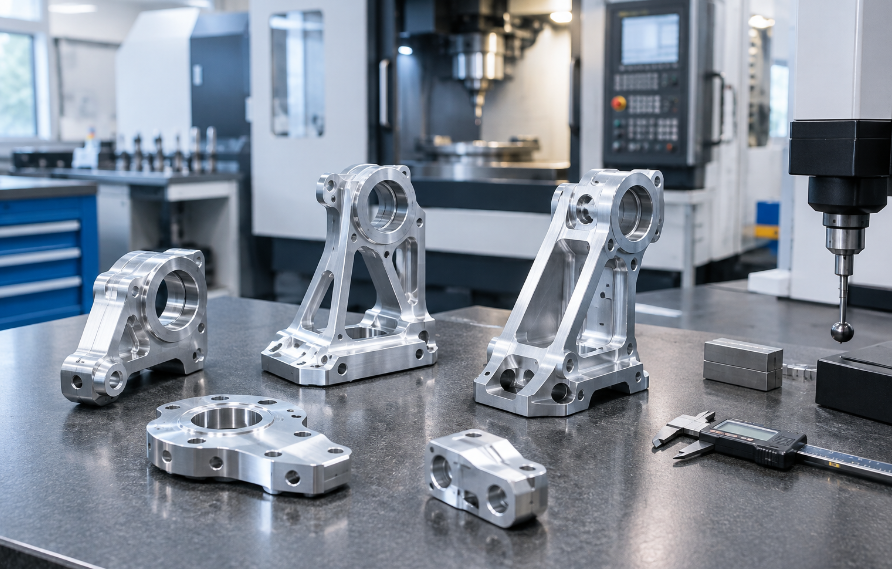
Humanoid robot joint actuation relies on accurately manufactured mechanical interfaces to connect motors, transmit torque, and measure rotational movement. Three important components are motor mounts, gearbox housings, and encoder brackets. Each serves a different purpose within the joint assembly.
★ Motor Mounts
Motor mounts provide a stable interface between the actuator and the joint frame. Their mounting surfaces, bolt-hole positions, and structural rigidity help maintain alignment under repeated movement. Lightweight aluminum alloys may be suitable for applications where reducing joint mass is important.
★ Gearbox Housings
Gearbox housings accommodate transmission mechanisms and support bearing and shaft locations. Precisely machined bores, locating surfaces, and fastening features help maintain the required geometric relationships between internal components. Housing design must also balance stiffness, weight, and available installation space.
★ Encoder Brackets
Encoder brackets secure position sensors near rotating shafts or joint output interfaces. Their locating features must match sensor installation requirements to support consistent position measurement. Compact bracket designs should also provide sufficient clearance for wiring, fasteners, and maintenance.
3. Component Requirements and CNC Machining Priorities
Different joint components have different functional requirements. The machining plan should reflect how each part interacts with the complete actuation system.
| Component | Main Function | Critical Features | CNC Machining Focus |
| Motor mount | Supports actuator installation | Mounting faces, bolt patterns | Face milling, drilling, tapping |
| Gearbox housing | Locates transmission components | Bearing bores, datum surfaces | CNC milling, boring, precision finishing |
| Encoder bracket | Positions the rotation sensor | Locating surfaces, mounting holes | Profile milling, drilling, dimensional verification |
Actual processes depend on the component geometry, material, tolerance requirements, and production volume.
4. Manufacturing Process for Custom Joint Parts
A controlled machining workflow helps reduce dimensional variation between mating components.
● Drawing review: Examine CAD models, critical dimensions, datum references, and geometric tolerances.
● Material preparation: Select aluminum alloy, steel, or titanium alloy according to weight, strength, stiffness, and cost requirements.
● Precision machining: Apply CNC milling, turning, drilling, or boring to produce functional surfaces and connection features.
● Edge finishing: Remove burrs and meet specified surface-finish requirements to support proper assembly.
● Quality inspection: Check critical dimensions, bore geometry, hole positions, and surface finish against approved drawings.
For multi-feature housings, consistent datums between machining operations help preserve the relationship between bearing seats and mounting interfaces.
5. Design Considerations for Reliable Assembly
Effective manufacturing requires the design to account for both machining and final assembly. Engineers should evaluate:
● Clearance between moving parts and adjacent structures.
● Bearing-seat dimensions and shaft alignment requirements.
● Wall thickness, structural stiffness, and weight limits.
● Fastener access, thread engagement, and cable routing.
● Inspection methods for critical dimensions and geometric tolerances.
Early design-for-manufacturing (DFM) review can identify difficult features and improve production feasibility before machining begins.
For information on robotics terminology and standardization, visit the International Organization for Standardization (ISO).
6. Custom CNC Machining for Humanoid Robot Projects
Humanoid robot development often involves prototype testing, design revisions, and subsequent production scaling. Manufacturers need clear technical specifications to evaluate each project's requirements.
Start Precision provides information about custom precision machining services. Visit its precision machining page to review manufacturing capabilities and equipment information.
Contact us to discuss your manufacturing needs and explore machining solutions for your humanoid robot joint components.
Frequently Asked Questions
1. What are the main Humanoid Robot Parts used in joint actuation?
Typical components include motor mounts, gearbox housings, encoder brackets, bearing supports, shafts, and structural connection plates.
2. Which materials are suitable for humanoid robot joint parts?
Aluminum alloys are often considered for lightweight structures. Steel may suit applications requiring specific strength or wear resistance, while titanium alloys can be evaluated for demanding strength-to-weight requirements.
3. Why is CNC machining important for joint components?
CNC machining can produce accurately positioned holes, bearing bores, mounting faces, and complex profiles that support component alignment and assembly consistency.
4. Can these components be customized from engineering drawings?
Yes. Custom machining projects can be assessed using customer drawings, CAD models, material requirements, tolerances, and inspection specifications.
5. What information is needed for a machining quotation?
Provide 2D drawings, 3D CAD files, material requirements, surface-finish specifications, critical tolerances, order quantities, and any required inspection documents.
Add: Building 3No.277 Zhen'an Middle Road, Chang'an Town,Dongguan,Guangdong, China
Tel:+86-769-82855591
Copyright © 2019 All Rights Reserved Dongguan Start Precision Technology Co., Ltd. Tel: +86-769-82855591
Add: No. 277 Zhen'an Middle Road, Chang'an Town, Dongguan, Guangdong, China



 中文版
 English