Liquid Cooling Plate Machining with Serpentine Channels
Date:2026-10-26Article editor:Starting Point PrecisionViews:231. Understanding Serpentine Channel Cooling Plates
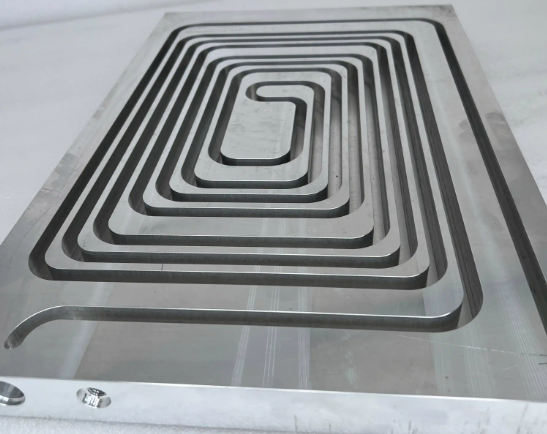
Liquid Cooling Plate Machining with serpentine channels creates a continuous coolant path beneath a heat-generating surface. This design is suitable for battery systems, power electronics, and high-density computing equipment where controlled heat removal is essential.
Unlike a straight passage, a serpentine channel routes coolant through repeated turns across the plate. Its performance depends on channel geometry, material conductivity, coolant flow, and the quality of the machined features.
2. Key Factors in Serpentine Channel Design
The channel layout should follow the heat distribution of the target component rather than simply maximize channel length.
● Flow path coverage: Position channels beneath critical heat sources to reduce localized temperature peaks.
● Channel dimensions: Set width and depth according to the required flow rate, available space, and minimum wall thickness.
● Bend geometry: Use suitable turning radii to limit excessive local resistance and avoid poorly flushed regions.
● Port positioning: Locate inlet and outlet connections to simplify assembly and maintain an effective coolant route.
● Plate strength: Preserve adequate material around channels, mounting holes, and sealing features.
A longer path may increase the coolant's contact area, but additional turns can also raise hydraulic resistance. The final geometry should balance heat transfer against the pumping capacity of the system.
3. How Channel Geometry Affects Performance
| Design factor | Potential benefit | Manufacturing or operating concern |
| Longer serpentine path | Greater coolant contact length | Increased frictional pressure loss |
| Rounded channel bends | Smoother directional changes | Requires accurate toolpath control |
| Wider channels | Lower flow resistance in suitable conditions | May reduce the available heat-transfer area |
| Deeper channels | Greater flow capacity | Can reduce the remaining plate thickness |
| Uniform channel spacing | More consistent surface cooling | Requires careful layout and machining control |
These relationships are design considerations, not universal performance guarantees. Actual results depend on the coolant, flow rate, heat load, and complete channel configuration.
For additional technical context, see this published study on liquid-cooled plate channel configurations.
4. Managing Pressure Drop at Channel Turns
Every bend changes the direction of coolant flow and contributes to local pressure loss. When the path contains many tight turns, the combined resistance may require greater pump power to maintain the intended flow rate.
A practical optimization process includes:
● Avoiding unnecessarily sharp turns and sudden changes in channel cross-section.
● Evaluating the inlet, straight passages, bends, and outlet as one hydraulic system.
● Using computational fluid dynamics (CFD) to identify high-resistance areas before production.
● Comparing predicted pressure drop with the system's allowable operating range.
● Confirming the final design through flow testing.
The goal is to deliver adequate cooling without imposing excessive pressure loss. Adding more turns is not automatically an improvement; the best configuration depends on the application's thermal and hydraulic requirements.
5. CNC Machining Accuracy and Quality Inspection
Accurate channel dimensions help maintain consistent flow conditions and predictable heat transfer. Errors in depth, width, flatness, or sealing-groove geometry can affect performance and assembly reliability.
A typical manufacturing workflow includes:
1. Drawing review: Check CAD geometry, dimensional tolerances, material specifications, and sealing requirements.
2. Material preparation: Confirm the selected metal grade and stock dimensions.
3. CNC milling: Machine the cooling passages, mounting features, ports, and sealing surfaces.
4. Deburring and cleaning: Remove accessible burrs and machining residues that could contaminate coolant passages.
5. Dimensional inspection: Verify channel geometry, plate flatness, hole positions, and critical mating surfaces.
6. Leak testing: Apply the specified test method and acceptance criteria to confirm fluid containment.
For machining capability information, visit Start Precision and its precision machining page.
6. Verifying Temperature Uniformity
Dimensional inspection alone cannot confirm cooling effectiveness. A thermal test should reproduce the intended operating conditions as closely as practical.
Key measurements include:
● Maximum surface temperature: Identifies the hottest region under the specified heat load.
● Temperature spread: Measures the difference between the hottest and coolest monitored locations.
● Thermal resistance: Evaluates the temperature rise relative to the heat transferred.
● Pressure drop: Measures the pressure difference between the inlet and outlet.
● Coolant flow rate: Confirms that the plate receives the intended fluid supply.
During validation, apply a controlled heat load and maintain defined coolant inlet temperature and flow conditions. Place temperature sensors at representative locations and record readings after the system stabilizes.
Acceptance limits should be established from the customer's application requirements. This approach helps determine whether the plate achieves an appropriate balance between thermal uniformity and pumping demand.
7. Custom Liquid Cooling Plate Manufacturing
A successful cooling plate requires coordinated design, machining, inspection, and testing. Reviewing the CAD model before production can reveal inaccessible features, weak channel walls, and potential sealing problems early.
When requesting a quotation, prepare:
● 2D drawings and 3D CAD files.
● Material grade and surface-finish requirements.
● Channel dimensions and connection specifications.
● Coolant type, operating flow rate, and pressure limits.
● Dimensional tolerances and leak-test criteria.
Contact Start Precision to discuss your manufacturing requirements and identify a suitable approach for your custom liquid cooling plate.
Frequently Asked Questions
1. What is the main advantage of serpentine channels?
They provide an extended flow path across the cooling surface, which can improve heat transfer when the geometry and operating conditions are properly selected.
Possible approaches include optimizing bend radii, adjusting channel dimensions, avoiding abrupt transitions, and validating the design through simulation and flow testing.
Aluminum is commonly considered because of its thermal conductivity, low weight, and machinability. Copper or other materials may be selected when the application requires different thermal or mechanical properties.
A controlled heat source, defined coolant conditions, and multiple temperature measurement points are used to evaluate the maximum temperature and temperature spread across the plate.
The required testing depends on the product specification and application. For fluid-containing plates, an appropriate leak test is an important verification step before use.
Add: Building 3No.277 Zhen'an Middle Road, Chang'an Town,Dongguan,Guangdong, China
Tel:+86-769-82855591
Copyright © 2019 All Rights Reserved Dongguan Start Precision Technology Co., Ltd. Tel: +86-769-82855591
Add: No. 277 Zhen'an Middle Road, Chang'an Town, Dongguan, Guangdong, China



 中文版
 English