Liquid Cold Plate Machining for IGBT Modules
Date:2026-09-22Article editor:Starting Point PrecisionViews:203An IGBT module can dissipate several kilowatts from a footprint smaller than a smartphone. Air cooling runs out of capacity long before that point, so power-electronics engineers turn to liquid cold plates — machined metal channels that carry coolant directly beneath the substrate. The final performance of that thermal stack depends less on the coolant than on how the plate is made. Channel geometry, flatness, wall thickness and joint integrity decide whether a module runs at 65 °C or drifts toward 125 °C. For background on switching losses and thermal behaviour, see the IGBT overview on Wikipedia.
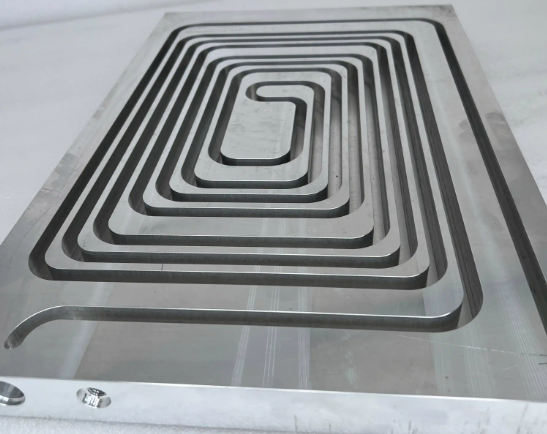
Heat fluxes of 100–300 W/cm² leave little margin. A cold plate must:
● Hold flatness across the module mating area so the thermal interface material (TIM) stays thin
● Keep parallel channel paths balanced, or one die runs hot while others idle
● Resist internal pressure without bulging or cracking at welded seams
● Stay leak-tight for years of thermal cycling
Each of these is set by machining and joining decisions, not by the drawing alone.
| Feature | Typical requirement | Consequence if missed |
| Mating surface flatness | 0.02–0.05 mm over module area | Thick TIM, hot spots |
| Surface roughness | Ra ≤ 0.8 µm | Poor TIM wetting |
| Channel depth | ±0.05 mm | Uneven flow, cavitation |
| Wall thickness | 1.0–2.0 mm | Weight vs. burst pressure |
| Locating features | ±0.01 mm | Mounting stress, cracked substrate |
| Helium leak rate | < 1 × 10⁻⁶ mbar·L/s | Coolant ingress, module failure |
Step 1 — DFM review. We check channel width, tool reach and wall thickness against 3D CAD before quoting.
Step 2 — 5-axis CNC milling. Pocket floors, fins and micro-channels cut in one setup where possible to protect datums.
Step 3 — Joining. Friction stir welding or vacuum brazing for lid and fitting assemblies.
Step 4 — Stress relief and finish facing. Restores flatness lost to weld distortion.
Step 5 — Verification. Helium leak test, CMM dimensional report, flow and pressure-drop check.
| Material | Thermal conductivity | Best suited to |
| AL6061-T6 | ~167 W/m·K | Standard EV and industrial inverters |
| AL6063 | ~200 W/m·K | Extruded base plates |
| C11000 copper | ~390 W/m·K | Traction IGBTs, high heat flux |
| CuCrZr | ~320 W/m·K | Welded copper assemblies |
| 316L stainless | ~16 W/m·K | DI water and corrosive coolants |
● Weld distortion — pre-machining allowances plus post-weld facing.
● Galvanic corrosion — we flag mixed aluminium/copper loops and recommend inhibitor chemistry.
● Burrs in micro-channels — controlled deburring keeps pressure drop predictable.
● Fitting leaks — threaded ports sealed with O-rings rated for glycol service.
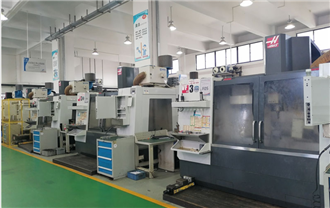
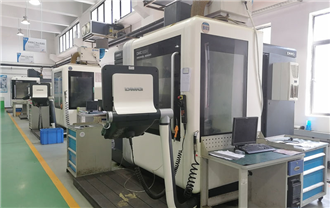
At Start Point Precision, cold plates are produced on CNC milling, CNC turning, surface and cylindrical grinding, wire cutting and EDM equipment, holding tolerances within ±0.01 mm against customer 3D and CAD data. Our engineers came from production plants, so DFM feedback arrives with the quote rather than after the first article. Complex geometries, non-standard fittings and mixed-material assemblies are routine, and every plate ships with dimensional and leak-test documentation. Parts serve aerospace, medical, automotive, electronics and communication programmes.
Contact us to discuss your manufacturing requirements.
Q1:Can you machine cold plates with internal channels that cannot be milled from one side?
Yes. We mill open channels and close them by friction stir welding, vacuum brazing or a bonded lid, then re-face the mating surface.
Q2:What flatness can you hold on a 200 mm aluminium cold plate?
Typically 0.02–0.05 mm over the module footprint, verified on CMM after stress relief.
Q3:Do you offer leak testing as part of the process?
Yes — helium mass-spectrometry leak testing and pressure decay testing are available, with reports supplied per batch.
Q4:Which file formats do you need for a quote?
STEP or IGES 3D models plus 2D drawings noting critical tolerances, surface finish and coolant port specifications.
Q5:Can you work with copper and aluminium in the same assembly?
We can, but we will advise on isolation or coating to prevent galvanic corrosion in the coolant loop.

Add: Building 3No.277 Zhen'an Middle Road, Chang'an Town,Dongguan,Guangdong, China
Tel:+86-769-82855591
Copyright © 2019 All Rights Reserved Dongguan Start Precision Technology Co., Ltd. Tel: +86-769-82855591
Add: No. 277 Zhen'an Middle Road, Chang'an Town, Dongguan, Guangdong, China



 中文版
 English