Liquid Cooling Plate Machining for Prototype Builds
Date:2026-10-02Article editor:Starting Point PrecisionViews:190
Developing a new thermal management system often requires functional prototypes before moving to larger production volumes. Liquid Cooling Plate Machining provides engineers with customized cooling plates for evaluating thermal performance, channel layouts, sealing structures, and installation requirements. Prototype machining also makes it easier to adjust the design according to test results.
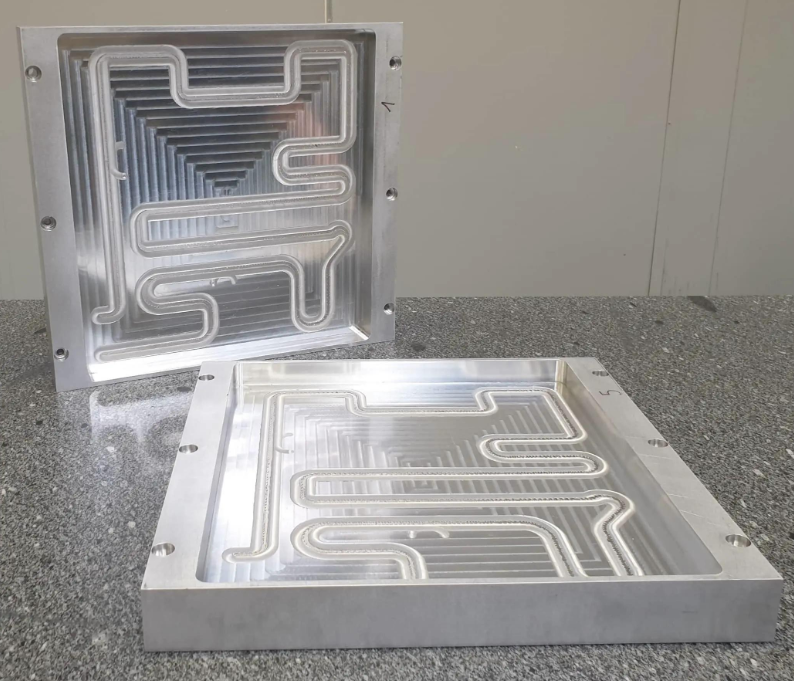
Prototype projects normally require flexibility rather than high-volume production. CNC machining allows manufacturers to produce a limited number of cooling plates without investing in dedicated molds.
• Small-batch CNC: Produce only the quantity required for engineering tests and early-stage evaluation.
• Fast delivery: Shorter production cycles help engineering teams move from design to physical testing quickly.
• Design validation: Verify cooling channels, mounting holes, fluid ports, sealing areas, and critical dimensions.
• Iterative optimization: Modify the design after thermal, pressure, or assembly testing and produce updated prototypes.
Prototype manufacturing requires close attention to both the drawing and the intended application. The machining strategy can be adjusted according to channel geometry, material, tolerances, sealing requirements, and expected testing conditions.
| Stage | Prototype Manufacturing Focus |
| Design Review | Check CAD geometry, critical dimensions, channel layout, ports, and sealing features |
| Material Preparation | Select suitable material according to thermal and mechanical requirements |
| CNC Machining | Machine channels, ports, mounting holes, and contact surfaces |
| Precision Finishing | Improve flatness, surface finish, and sealing-related features |
| Inspection | Verify dimensions and critical geometric requirements |
| Testing | Perform leak or pressure testing when specified |
| Design Iteration | Apply test feedback to the next prototype version |
This approach helps engineers identify manufacturing or assembly issues before committing to larger production quantities.
Liquid cooling plates can contain internal channels, threaded ports, O-ring grooves, mounting features, and large flat thermal-contact surfaces. Small changes to any of these features may affect performance or assembly.
With CNC machining, prototype designs can be updated without creating a new mold. For example, engineers may change channel dimensions, reposition fluid ports, modify sealing grooves, or adjust mounting holes after the first round of testing.
For additional precision manufacturing information, visit Start Precision.
An external technical reference such as U.S. Department of Energy can also provide background information related to energy-efficient thermal management and advanced energy technologies.
A prototype project for compact power electronics required several liquid cooling plates for functional testing. The first design included multiple cooling channels and limited installation space.
• The initial plate was produced in a small batch for assembly and thermal testing.
• Test feedback identified areas where channel geometry could be refined.
• Fluid-port and sealing features were adjusted for improved integration.
• A second prototype was machined using the revised design.
This iterative method allowed the engineering team to validate the updated structure before preparing the component for higher-volume manufacturing.
Liquid cooling plate prototypes can support development in:
• Data center cooling systems
• EV battery thermal management
• IGBT and power module cooling
• Renewable energy equipment
• Industrial electronic systems
Liquid Cooling Plate Machining for Prototype Builds gives engineering teams a practical way to test and refine custom cooling designs before production. Small-batch CNC machining, fast delivery, dimensional inspection, and iterative design support can shorten development cycles while helping identify potential issues at an early stage.
Contact us to discuss your manufacturing needs.
FAQ
Q1: Can liquid cooling plates be CNC machined in small quantities?
Yes. CNC machining is suitable for prototype and low-volume cooling plates because it does not require dedicated production molds.
Q2: What can be modified during prototype development?
Cooling channels, fluid ports, mounting holes, sealing grooves, dimensions, and surface features can be modified according to test results.
Q3: Can prototype cooling plates undergo leak testing?
Yes. Leak or pressure testing can be included when required by the application or engineering specification.
Q4: What materials can be used for prototype cooling plates?
Aluminum alloys are commonly selected for their combination of thermal conductivity, low weight, and machinability. Other materials can be considered according to application requirements.
Q5: Why use several prototype iterations?
Multiple iterations allow engineers to identify design, sealing, assembly, and thermal-management issues before moving toward larger production quantities.

Add: Building 3No.277 Zhen'an Middle Road, Chang'an Town,Dongguan,Guangdong, China
Tel:+86-769-82855591
Copyright © 2019 All Rights Reserved Dongguan Start Precision Technology Co., Ltd. Tel: +86-769-82855591
Add: No. 277 Zhen'an Middle Road, Chang'an Town, Dongguan, Guangdong, China



 中文版
 English