Complete Metal Parts Support CNC Machining for Humanoid Robots
Date:2026-09-24Article editor:Starting Point PrecisionViews:181Humanoid robots require many precisely manufactured metal components to coordinate movement, sensing, power transmission, and structural support. From compact joint housings to lightweight structural links, each part must meet its specific dimensional, mechanical, and assembly requirements. CNC machining offers a flexible manufacturing solution for developing and producing these complex metal components.
Humanoid robot assemblies often contain parts with irregular contours, precision bores, threaded holes, pockets, mounting interfaces, and close positional relationships. CNC machining allows these features to be produced directly from digital CAD data while maintaining repeatable dimensional control.
Typical applications include:
● Joint housings and actuator covers
● Motor mounting plates and brackets
● Bearing seats and rotating components
● Structural links and support arms
● Sensor brackets and equipment mounts
● Output flanges and connector components
● End-effector and hand components
For complex geometries, multi-axis machining can reduce the number of setups and improve access to difficult surfaces.
Material selection directly influences component weight, stiffness, strength, wear resistance, and machinability.
| Material | Typical Characteristics | Possible Applications |
| 6061 Aluminum | Lightweight, machinable, corrosion resistant | Brackets, housings, structural parts |
| 7075 Aluminum | High strength-to-weight ratio | Joint parts, actuator components |
| Stainless Steel | Strong and corrosion resistant | Shafts, mounts, precision interfaces |
| Titanium Alloy | High strength with low density | Lightweight load-bearing components |
| 17-4 PH Stainless Steel | High strength and hardness | Precision mechanical parts |
The final material should be selected according to the component's actual load, operating environment, weight requirements, and engineering specifications.
A reliable manufacturing process should cover the entire path from engineering review to finished delivery.
| Stage | Main Focus |
| Drawing Review | Check dimensions, tolerances, datums, threads, and critical features |
| Material Preparation | Confirm material grade and stock dimensions |
| Rough Machining | Remove excess material while maintaining part stability |
| Precision Machining | Finish bores, pockets, mounting faces, and contours |
| Multi-Axis Machining | Machine complex surfaces with fewer setups |
| Deburring & Finishing | Remove burrs and prepare functional surfaces |
| Inspection | Verify critical dimensions, position, flatness, and geometry |
| Final Preparation | Cleaning, documentation, packaging, and delivery |
This integrated approach helps connect design requirements with practical machining methods.
Precision is particularly important where several components must work together. Bearing seats, motor interfaces, mounting holes, shafts, and joint connections may require tighter dimensional and geometric control than non-functional surfaces.
Depending on the project, inspection may include:
● Dimensional measurement
● Hole position verification
● Flatness and perpendicularity checks
● Bore and shaft inspection
● Surface-finish verification
● CMM inspection for critical geometries
Inspection requirements should be defined before production so that the manufacturing and quality-control processes are aligned with the engineering drawing.
A humanoid robot joint housing may combine bearing bores, mounting holes, internal pockets, and motor interfaces in one compact component. A practical machining strategy can establish the primary datum first, rough-machine the main structure, and then finish the critical interfaces in controlled setups.
After machining, the component can undergo deburring, cleaning, surface treatment when required, and dimensional inspection. This sequence helps prepare the part for consistent assembly with bearings, motors, shafts, and adjacent structural components.
When developing custom humanoid robot components, providing complete engineering information can make manufacturing evaluation more efficient. CAD models, drawings, material specifications, quantities, tolerances, surface treatment requirements, and inspection standards are useful starting points.
You can learn more about custom CNC manufacturing capabilities through the Start Precision website.
For additional robotics background, the NASA Robonaut program provides publicly available information about humanoid robotic development.
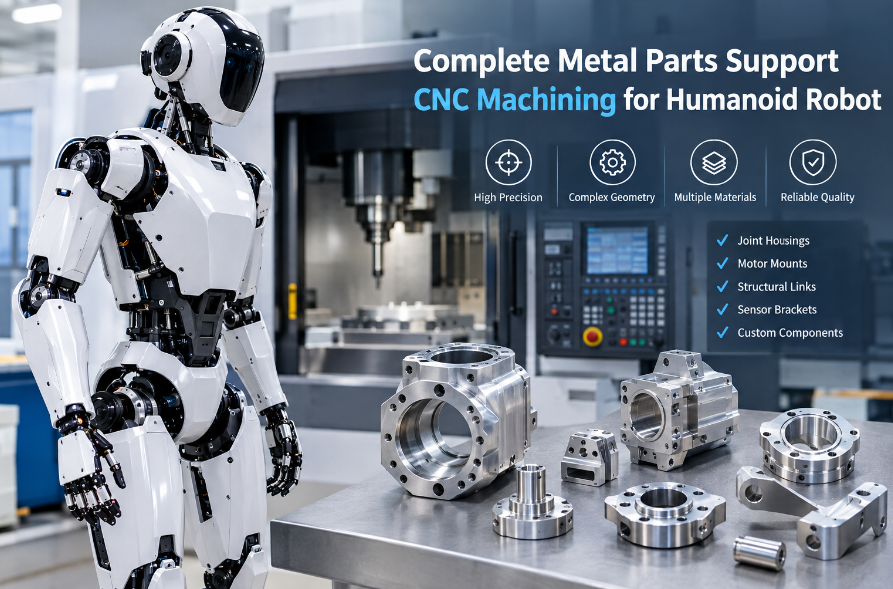
Complete metal parts support for humanoid robots involves more than machining individual components. Material selection, CNC process planning, dimensional control, finishing, and inspection must work together to meet the requirements of each robotic assembly.
For custom robot components, contact us to discuss your manufacturing needs, technical requirements, and CNC machining project.
1. What metal parts can be CNC machined for humanoid robots?
CNC machining can produce joint housings, actuator brackets, bearing seats, motor mounts, structural links, sensor mounts, flanges, and end-effector components.
2. Which materials are commonly used for humanoid robot parts?
6061 aluminum, 7075 aluminum, stainless steel, titanium alloys, and 17-4 PH stainless steel are common options, depending on the component's requirements.
3. Why is CNC machining suitable for humanoid robot components?
CNC machining can produce complex geometries directly from CAD data and is suitable for prototypes, low-volume production, and repeat manufacturing.
4. When should 5-axis CNC machining be considered?
It can be considered for parts with complex angled surfaces, curved profiles, or features distributed across multiple faces.
5. What files are needed for a CNC machining quotation?
A 3D CAD model and 2D drawing are preferred. Material, quantity, tolerances, surface treatment, and inspection requirements should also be provided when available.
Add: Building 3No.277 Zhen'an Middle Road, Chang'an Town,Dongguan,Guangdong, China
Tel:+86-769-82855591
Copyright © 2019 All Rights Reserved Dongguan Start Precision Technology Co., Ltd. Tel: +86-769-82855591
Add: No. 277 Zhen'an Middle Road, Chang'an Town, Dongguan, Guangdong, China



 中文版
 English