Liquid Cooling Plate Machining with Microchannel Design
Date:2026-09-25Article editor:Starting Point PrecisionViews:167Microchannel liquid cooling plates provide efficient heat removal for high-power electronics in compact spaces. By using narrow, closely spaced cooling channels, the design increases coolant contact with the heated surface while controlling the overall plate size.
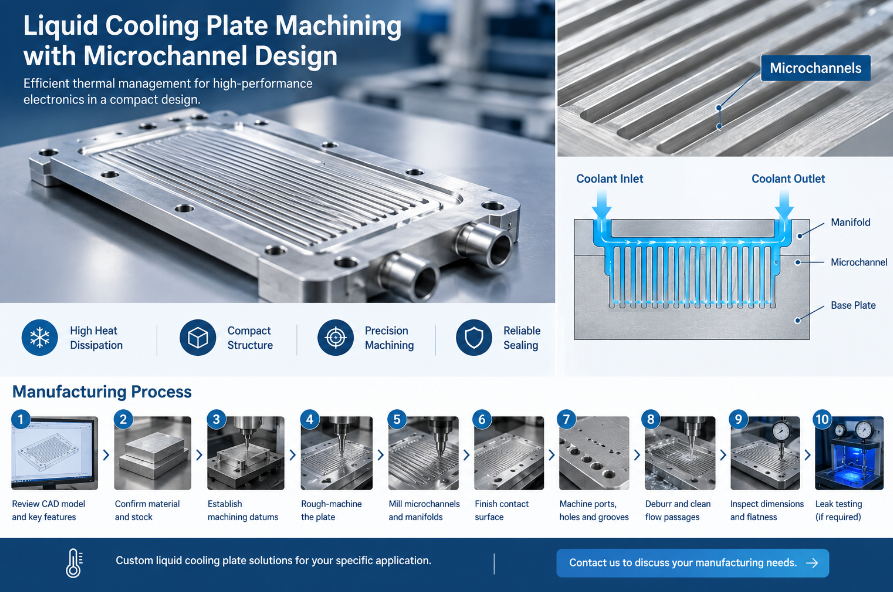
Successful Liquid Cooling Plate Machining requires a balance between thermal performance and manufacturability. Key design factors include:
● Channel width and depth
● Depth-to-width aspect ratio
● Channel pitch and wall thickness
● Inlet and outlet manifold design
● Required coolant flow rate
● Pressure drop
● Sealing and surface-flatness requirements
Narrower channels can improve heat-transfer performance, but they may also increase flow resistance and machining difficulty. NASA research on microchannel cooling also emphasizes balancing heat transfer and pressure drop. NASA Technical Reports.
Our production process is based on the actual cooling plate geometry and application requirements:
1. Review the CAD model and thermal/sealing features.
2. Confirm material and stock dimensions.
3. Establish machining datums.
4. Rough-machine the plate.
5. CNC mill the microchannels and manifolds.
6. Finish the thermal contact surface.
7. Machine ports, mounting holes, and sealing grooves.
8. Deburr and clean the flow passages.
9. Inspect dimensions and flatness.
10. Perform leak testing when required.
For suitable designs, precision CNC milling provides controlled channel dimensions and repeatable production. The machining strategy is adjusted according to channel size, material, tolerance, and production volume.
For more precision manufacturing information, visit Start Precision.
Channel dimensions directly affect coolant flow. Increasing channel length or reducing hydraulic diameter can increase pressure drop, while manifold design influences flow distribution.
Therefore, we consider channel geometry, flow rate, pressure drop, and heat-load distribution together rather than optimizing a single parameter.
Microchannel cooling plates are suitable for:
● AI servers, CPUs, and GPUs
● IGBT and power electronics
● EV inverters and power systems
● Laser equipment
● Renewable-energy equipment
● Aerospace electronics
For a high-power electronic module, a customized cooling plate can use parallel microchannels beneath the primary heat source. The channel layout and manifold can be adjusted to distribute coolant more effectively across high-heat areas.
After channel machining, the contact surface, ports, and sealing grooves are finished according to the assembly requirements. Dimensional inspection and leak testing can then verify the finished plate before shipment.
Liquid Cooling Plate Machining with Microchannel Design combines precision CNC manufacturing with careful control of channel geometry and coolant flow. Channel width, aspect ratio, pressure drop, flow rate, material, and sealing requirements should all be considered during production.
Contact us to discuss your manufacturing requirements and develop a precision liquid cooling plate solution for your application.
FAQs
1. What is a microchannel cooling plate?
It is a liquid cooling plate with narrow internal channels designed to improve heat transfer.
2. Can microchannels be CNC machined?
Yes. CNC machining can produce customized microchannels when the channel geometry and material are suitable.
3. How does channel size affect pressure drop?
Smaller or longer channels generally increase flow resistance, so channel dimensions must be matched to the required flow rate.
4. Can Start Precision provide leak testing?
Yes. Leak testing can be included when required by the application or customer specification.

Add: Building 3No.277 Zhen'an Middle Road, Chang'an Town,Dongguan,Guangdong, China
Tel:+86-769-82855591
Copyright © 2019 All Rights Reserved Dongguan Start Precision Technology Co., Ltd. Tel: +86-769-82855591
Add: No. 277 Zhen'an Middle Road, Chang'an Town, Dongguan, Guangdong, China



 中文版
 English