CNC Machining Parts: Achieving Smooth Surface Finishes for Aesthetic Applications
Date:2026-01-26Article editor:Starting Point PrecisionViews:719In today's market, the quality of a product is often judged first by its appearance. For components used in consumer electronics, automotive interiors, medical devices, and luxury goods, a flawless surface finish is not a luxury—it’s a requirement. CNC (Computer Numerical Control) machining, renowned for its precision, is also capable of producing exceptionally smooth, aesthetically superior surfaces when paired with the right techniques and expertise.
The Aesthetic Imperative in Modern Manufacturing
Gone are the days when machining was solely for hidden, functional parts. Modern design integrates components, making them visible and tactile. A rough or visibly tool-marked surface can detract from user perception, suggesting poor quality. Conversely, a smooth, consistent finish conveys precision, durability, and high value. Applications demanding such finishes include:
Consumer Electronics: Bezels, buttons, and enclosures.
Automotive: Interior trim, dashboard components, and exposed fittings.
Medical Devices: Handles, casings, and patient-facing parts requiring cleanability.
Aerospace: Visible cabin components and fittings.
Key CNC Techniques for Superior Surface Finishes
Achieving a mirror-like or tactilely smooth finish involves a multi-stage process, moving from primary machining to final polishing.
1. Precision Machining: The Foundation
The journey begins with optimized CNC milling or turning. Key factors here include:
Tool Selection: Using sharp, micro-grain carbide tools or diamond-tipped tools for non-ferrous materials.
Climb Milling: This technique provides a cleaner shearing action, reducing burrs and improving surface texture.
Reduced Stepovers: Overlapping tool paths by a very small amount (e.g., 5-10% of tool diameter) minimizes visible cusp marks.
High Spindle Speeds with Slow Feed Rates: This combination allows for finer cuts, which is crucial for initial surface quality.
2. Secondary Finishing Processes
After machining, several processes enhance smoothness:
Hand Polishing: Skilled technicians use progressively finer abrasives to achieve a mirrored surface. Labor-intensive but highly effective for complex geometries.
Tumbling/Vibratory Finishing: Parts are placed in a media-filled tub to deburr and smooth surfaces through friction. Ideal for large batches.
Abrasive Flow Machining (AFM): A viscous abrasive media is forced over the part's surface, perfecting edges and difficult-to-reach internal passages.
Electropolishing: An electrochemical process that removes a microscopic layer of material, leveling peaks and valleys. It is excellent for stainless steel and other alloys, enhancing corrosion resistance and brightness. Learn about industry standards for finishes at the American Society of Mechanical Engineers website.
The Role of Material Choice
The base material significantly influences the achievable finish:
Aluminum (e.g., 6061. 7075): Machines beautifully and can be polished to a high gloss or anodized for a durable, colored finish.
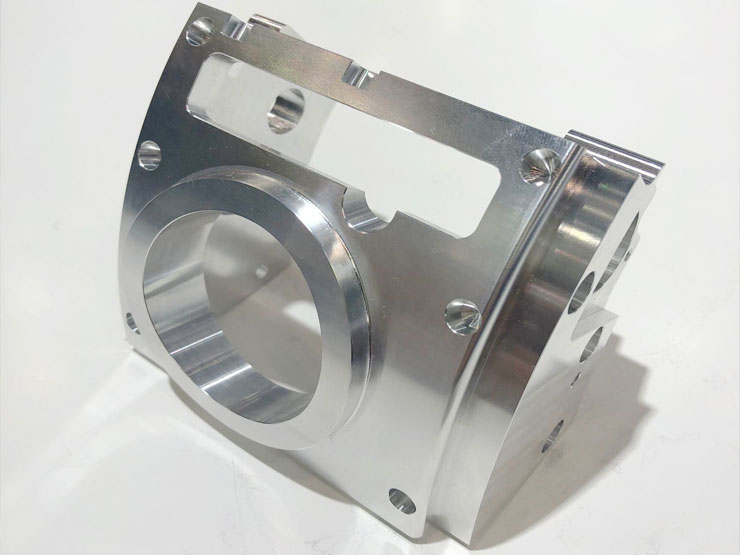
A polished aluminum CNC part
Stainless Steel (e.g., 304. 316): Offers excellent polishability and is often electropolished for a hygienic, shiny surface.
Brass and Copper: Naturally amenable to high-polish finishes and patinas.
Plastics (e.g., Acrylic/PMMA, Delrin): Can be machined to optical clarity or a soft matte finish.
Conclusion: A Symphony of Technology and Skill
Delivering CNC machined parts with a flawless surface for aesthetic applications is a synergistic process. It requires not only advanced CNC programming and state-of-the-art machinery but also a deep understanding of post-processing techniques and material science. The result is a component that excels not just in function, but in form and feel—meeting the highest standards of modern design and consumer expectation.
For designers and engineers, it is critical to specify surface finish requirements (using Ra or Rz metrics) and aesthetic intent early in the design phase. Collaborating with a knowledgeable CNC machining partner who can guide on design for manufacturability (DFM) for aesthetics is the key to success. Contact our team for a consultation on your next aesthetic-critical project.
Add: Building 3No.277 Zhen'an Middle Road, Chang'an Town,Dongguan,Guangdong, China
Tel:+86-769-82855591
Copyright © 2019 All Rights Reserved Dongguan Start Precision Technology Co., Ltd. Tel: +86-769-82855591
Add: No. 277 Zhen'an Middle Road, Chang'an Town, Dongguan, Guangdong, China



 中文版
中文版 English