CNC Machining Parts: Automated Inspection for Quality Assurance
Date:2026-01-26Article editor:Starting Point PrecisionViews:669In the world of precision manufacturing, quality is non-negotiable. For CNC machined parts, especially those used in aerospace, medical, and automotive industries, dimensional accuracy is paramount. While skilled machinists and advanced CNC machines form the production backbone, Automated Inspection has become the critical guardian of quality assurance (QA), ensuring every component meets stringent specifications.
The Limitations of Manual Inspection
Traditional manual inspection using calipers and micrometers is time-consuming, prone to human error, and impractical for high-volume production or complex geometries. It often involves only random spot-checking, leaving room for undetected defects. Automated inspection solves these challenges by providing speed, consistency, and comprehensive data capture.
Core Automated Inspection Technologies
Modern QA labs integrate several key technologies to verify CNC part quality:
1. Coordinate Measuring Machines (CMM)
A stalwart in precision metrology, CMMs use a tactile probe to measure physical points on a part's surface. Modern CNC-driven CMMs can run pre-programmed inspection routines unattended.
Application: Ideal for validating critical dimensions, geometric tolerances (flatness, concentricity), and first-article inspection. Learn about our capabilities on our CMM inspection page .
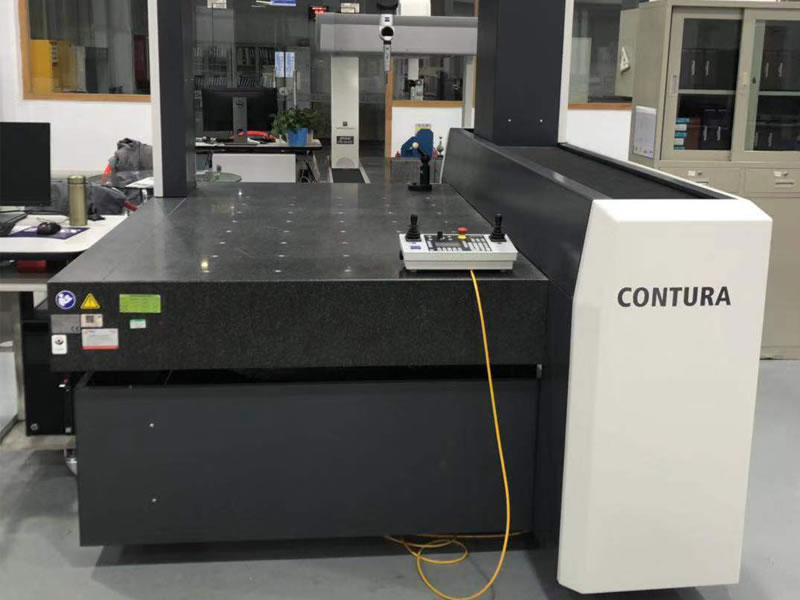
A Coordinate Measuring Machine(CMM)
2. 3D Laser Scanners & Structured Light Scanners
These non-contact systems capture dense point clouds of a part's entire surface geometry in seconds.
Application: Perfect for reverse engineering, inspecting free-form surfaces, and conducting full deviation analysis by comparing the scanned model directly to the original CAD file. This is crucial for aerospace and turbine blades.
3. Computer Vision & Automated Optical Inspection (AOI)
Equipped with high-resolution cameras and intelligent software, these systems perform rapid visual and dimensional checks.
Application: Excellent for detecting surface defects (scratches, dents), verifying feature presence, and measuring 2D dimensions. Widely used for high-volume production of consumer electronics and automotive components.
4. In-Process Probing
Touch probes integrated directly into the CNC machine tool allow for measurement during the machining process.
Application: Used for on-machine part setup verification, tool wear compensation, and mid-process checks. This enables closed-loop manufacturing, where the machine can adjust its own operations based on inspection data, preventing scrap.
The Automated Inspection Workflow & Data Advantage
A robust automated QA process follows a streamlined workflow:
Planning: Inspection points and paths are programmed directly from the part's CAD model.
Execution: The part is loaded, and the system runs the inspection routine automatically.
Analysis: Software generates detailed reports, including color-coded deviation maps.
Decision: Data is used to accept the part, flag issues, or trigger machine adjustments.
The true power lies in data analytics. Automated systems collect statistical process control (SPC) data over time, identifying trends—like gradual tool wear—before they cause out-of-tolerance parts. This shift from reactive to predictive quality control is transformative.
Integration with Quality Management Systems
Automated inspection data seamlessly integrates with overarching Quality Management Systems (QMS) and industry standards like ISO 9001 and AS9100. This creates a digital thread, providing full traceability from raw material to finished part—a requirement in regulated industries. For more on standards, visit the International Organization for Standardization.
Conclusion: The Indispensable Partner to CNC Machining
Automated inspection is no longer a luxury but a necessity for competitive precision manufacturing. It ensures that the theoretical precision of CNC machining is confirmed in the physical part with objective, data-driven proof. By investing in technologies like CMM, 3D scanning, and vision systems, manufacturers guarantee not just compliance, but also higher throughput, reduced waste, and unwavering customer trust.
For engineers and buyers, partnering with a CNC machine shop that prioritizes integrated automated QA means receiving parts with verified quality and complete documentation, ensuring your projects move forward with confidence.
Add: Building 3No.277 Zhen'an Middle Road, Chang'an Town,Dongguan,Guangdong, China
Tel:+86-769-82855591
Copyright © 2019 All Rights Reserved Dongguan Start Precision Technology Co., Ltd. Tel: +86-769-82855591
Add: No. 277 Zhen'an Middle Road, Chang'an Town, Dongguan, Guangdong, China



 中文版
中文版 English