Humanoid Robot Parts in Lightweight Alloys
Date:2026-09-28Article editor:Starting Point PrecisionViews:217Humanoid robots require a careful balance between low mass, structural rigidity, durability, and machining accuracy. Components such as joint housings, arm links, brackets, actuator mounts, and end-effector interfaces can benefit from lightweight alloys because reducing unnecessary mass helps designers manage moving loads and compact mechanical structures. Aluminum alloys are particularly attractive because they combine relatively low density with useful strength and established machining methods.
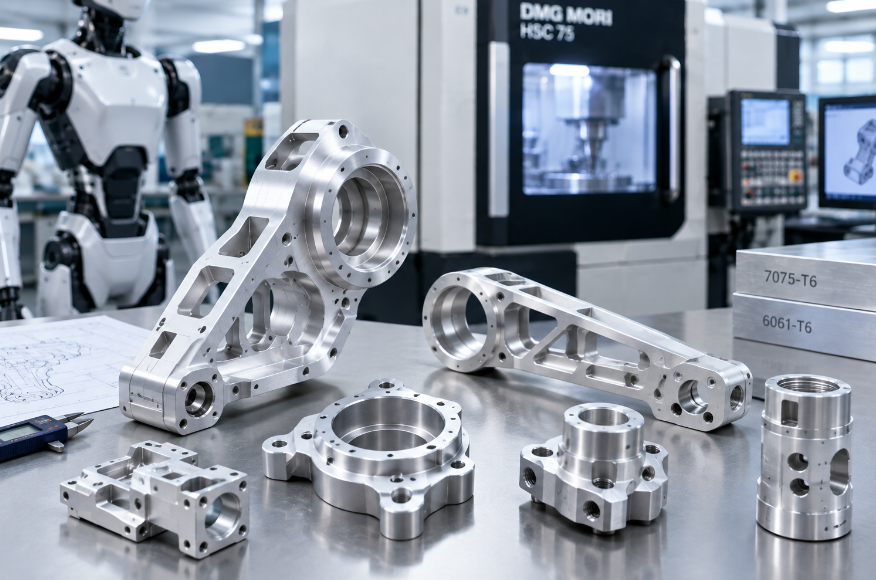
Lightweight Alloys for Humanoid Robot Parts
Material selection depends on the load, geometry, joint function, and required surface performance.
● 6061-T6 Aluminum: A practical choice for brackets, housings, structural links, and prototypes because it is machinable and corrosion resistant.
● 7075-T6 Aluminum: Suitable for strength-critical components where higher mechanical strength is required without moving to a heavier steel construction.
● Magnesium Alloys: Useful where aggressive mass reduction is a priority, although corrosion protection and manufacturing considerations require careful engineering.
● Titanium Alloys: Considered for selected high-load or high-temperature interfaces where strength-to-weight performance justifies higher material and machining costs.
Machining Requirements
Lightweight alloy parts often contain thin walls, deep pockets, curved surfaces, bearing seats, threaded holes, and multiple datum features. These characteristics make fixture stability and thermal control important during CNC machining.
● Machining: 3-axis, 4-axis and 5-axis CNC processing
● Features: Thin walls, pockets, bores, mounting holes, curved profiles
● Critical Areas: Bearing seats, joint interfaces, threaded holes, actuator mounts
● Finishing: Anodizing, polishing, blasting or other specified treatments
● Inspection: Dimensional inspection, surface verification and functional checks
Precision CNC Process
Rather than applying one fixed sequence to every robot component, the machining route is developed around the part's load-bearing areas and functional interfaces. The workflow can include CAD feature evaluation, material and fixture preparation, controlled rough cutting, multi-axis profile machining, precision boring, thread formation, edge finishing, surface treatment, and final dimensional verification.
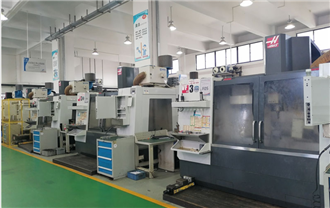
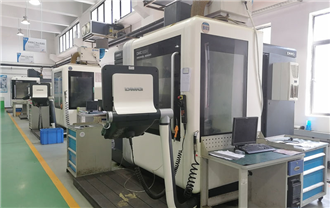
For complex humanoid robot geometry, five-axis machining can reduce repositioning and provide access to curved, angled, hollowed-out, and difficult-to-reach features. Start Precision's equipment list includes a Germany DMG HSC 75 linear five-axis machining center, along with DMG DMC 835V, Mazak VCN-510C, HAAS VF3, HAAS EC400, and CNC turning centers.
Lightweight Robot Part Quality Control
A lightweight structure still needs controlled interfaces. Inspection can focus on:
● Bearing and shaft-hole dimensions
● Mounting-hole position
● Flatness of joint interfaces
● Wall thickness and pocket depth
● Thread accuracy
● Surface condition after finishing
● Overall dimensional conformity
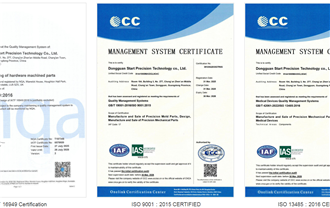
Quality documentation can be incorporated according to project requirements. For general quality-management information, ISO describes ISO 9001 as a framework for establishing, maintaining, and continually improving a quality management system.
Example: Lightweight Robot Joint Housing
Consider a humanoid robot shoulder housing machined from 7075-T6 aluminum. The component may combine a curved exterior, internal weight-reduction pockets, bearing bores, actuator mounting holes, and cable-routing openings.
A five-axis strategy can machine multiple angled features while maintaining controlled datums. After machining, deburring and surface treatment can improve the finished component's usability and appearance. Final inspection then verifies the bearing interface, mounting pattern, critical dimensions, and surface condition before assembly.
Conclusion
Humanoid Robot Parts made from lightweight alloys require more than simply removing material from a steel design. Alloy selection, structural geometry, fixture strategy, multi-axis machining, surface finishing, and inspection must be considered together. With an appropriate CNC manufacturing process, lightweight robot components can be produced with the dimensional consistency required for precision assemblies.
For CNC machining support for lightweight robotic components, visit the Start Precision homepage and discuss your drawings, materials, tolerances, and production requirements with the manufacturing team.
Contact us to discuss your manufacturing needs and customized robot-part requirements.
Add: Building 3No.277 Zhen'an Middle Road, Chang'an Town,Dongguan,Guangdong, China
Tel:+86-769-82855591
Copyright © 2019 All Rights Reserved Dongguan Start Precision Technology Co., Ltd. Tel: +86-769-82855591
Add: No. 277 Zhen'an Middle Road, Chang'an Town, Dongguan, Guangdong, China



 中文版
 English